
In B2B communication, a great email could turn a cold prospect into a meaningful conversion, whereas a poorly written email can be easily ignored within a matter of seconds.
The B2B market is becoming competitive day by day. Now, simply sending more and more generic emails doesn’t seem to work. To drive conversions, you should focus on creating messages that immediately capture attention, are fully personalized, address the recipient’s needs, and provide clarity about the next action.
In this blog post, we are going to explain how you can craft such emails by following the right strategies. So, without any delay, let’s get started!
Useful Strategies for Creating High-Converting B2B Emails
Here are the strategies that will help you to come up with high-converting B2B emails.
1. Always Define the Purpose of Your B2B Email
Before getting into the actual writing process, it is crucial for you to first define and set the purpose of your B2B email. The purpose heavily depends on the type of goal you want to achieve.
Some of the most common goals for B2B conversion emails include:
- Introducing a product or service
- Generating a sales lead
- Scheduling a follow-up meeting
- Encouraging an existing customer to take a specific action
When you have a clearly defined goal and purpose, it will become easier for you to decide what kind of information should be included and what should be avoided in the email. It also helps you keep the message relevant and focused instead of wasting the recipient’s time.
For example, if the purpose of your B2B email is to schedule a meeting with a prospect, then this means there is no need to explain product features and benefits in the initial message.
2. Do Not Forget to Research and Understand the Recipient
One of the primary reasons behind a failed B2B conversion email is a lack of research about the recipient. B2B buyers are intelligent and professional individuals who don’t get manipulated by traditional sales and email marketing tactics.
That’s why you should spend time and effort researching and understanding the following information:
- Who are you contacting?
- What problems are they dealing with?
- What kind of products and services are they looking for?
Besides this, it is also important to determine the authority they have in the decision-making process. For this, consider their job role, industry, company size, and potential goals.
After understanding all this information about the B2B recipient, you can easily frame the email content around the specific needs and preferences of the recipient, ultimately increasing the overall chances of conversions.
3. Create an Attention-Grabbing Subject Line
According to statistics, around 43% of recipients decide whether they should open or ignore the email by considering the subject line alone. This means the subject line is one of the very first things that the B2B recipient sees, so it should immediately grab their attention and encourage them to open and read the email.
There are many tactics that can be adopted in this regard. For example:
- You can make a curious statement by highlighting the potential benefit of your product and service
- You can also address the challenge they are facing.
- You can also ask a meaningful question.
Avoid making exaggerated claims. Instead, keep your subject line focused, relevant, and concise. To get a better idea, see the examples of both good and bad subject lines below.
Bad Subject Line:
“Our Amazing Solution is Finally Here”
Issue: Ambiguous with no clear purpose.
Good Subject Line:
“Seamlessly Manage Your Follow-Up Process with Our New Tool”
The second subject line is clearer and more specific, making the value of the email easier to understand.
4. Start with a Strong and Personalized Opening
“The First Impression is the Last Impression.” This famous saying also applies in the context of B2B emails. Your opening sentences play a pivotal role in deciding whether the recipient will take interest in your offering.
For this, you should always focus on making the email opening strong, engaging, and attention-grabbing. To do this, you can consider starting the conversation with the following:
- Specific observation
- Relevant challenge
- Potential opportunity
In short, you need to be highly relevant according to the specific needs and preferences of the recipient to maintain their interest. Avoid lengthy explanations and company introductions in the email opening. Be specific and concise.
Along with this, it is also important to keep the opening statement personalized. This will make the recipient feel valued, increasing the chances of future collaboration.
To achieve personalization, you could mention the person’s name, job role, responsibility, or any other relevant detail you gathered during the research process. Check out the good and bad examples of strong and personalized B2B email openings reaching out to an eCommerce business.
Bad Example:
“Hi there, hope you are fine. I want to introduce our platform to you.”
Good Example:
“Hi John, I noticed your store has recently expanded its product range. As the product catalog grows, keeping the information consistent across all pages becomes increasingly challenging and time-consuming.”
This statement is not only personalized but also relevant, as it highlights a potential challenge that may be relevant for the recipient.
5. Focus on Explaining Benefits, Not Features
One of the most common reasons behind a failed B2B conversion email is that businesses start promoting themselves. You should avoid this in the initial outreach. This is because you are not reaching out to a general customer; B2B buyers are intelligent and professional individuals who don’t get convinced so easily.
Therefore, you should focus on highlighting your product or service benefits instead of blunt promotion.
Example:
Suppose you are promoting automated campaign scheduling software. Instead of directly explaining the features:
“Our software supports automated campaign scheduling.”
You can explain the benefit in this way:
“Your team can schedule campaigns with our software in advance, reducing repetitive manual work and saving valuable time.”
This statement efficiently tells what the product does while also explaining why it matters for the recipient by highlighting the benefit.
6. Add a Clear and Concise CTA
When it comes to drafting a high-converting B2B email, CTA is one of the most crucial elements you should focus on. This is because a call-to-action can help guide the buyers towards the desired action once they are done reading the email.
There are multiple types of CTAs, such as:
- Button
- Clickable link
- Image/banner
When creating a CTA, you should keep one thing in mind – it should match the purpose of your B2B conversion email.
For example:
If your objective is to schedule a meeting with the B2B prospect, then you can consider adding a CTA that asks whether the recipient is available for a brief discussion. Similarly, if you want to follow up, you can ask whether the recipient has had a chance to review your proposal or discuss the next steps.
Note that creating a strong and relevant CTA is not enough; it is also essential to add it in a place where it is easy to notice, increasing the chances that the recipient will take action.
7. Take Help of Specialized Tools
Finally, it is true that creating B2B emails that drive conversions requires time and skill, especially when a marketing team needs to produce several emails each day. This increases the overall chances that the quality may be compromised.
That’s why it is considered an effective strategy to utilize advanced AI email writers. These tools help B2B businesses generate unique, engaging, and personalized high-conversion emails by simply providing a prompt.
For demonstration, we picked Email Writer and entered the following prompt to see how it responds.
“Write a B2B email introducing a project management platform. Personalize it around campaign management challenges, highlight key benefits, and end with a clear CTA to schedule a demo.”
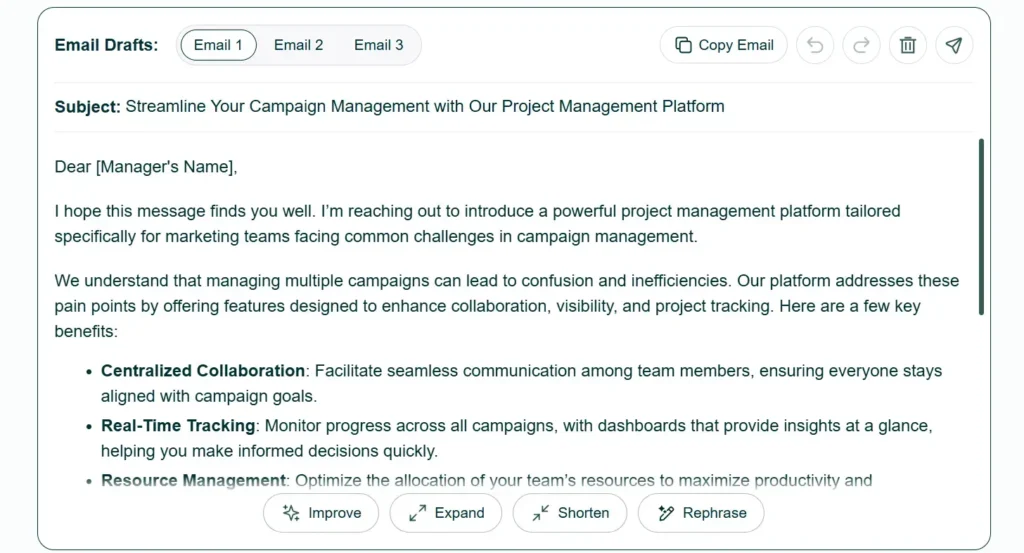
As shown in the screenshot, iLoveNote generated a draft based on the prompt. As a B2B business or marketer, you can fine-tune the draft a little more or utilize the refinement options offered by the tool to make it more appealing.
Bottom Line
B2B buyers are professional individuals. This means you cannot convert them by sending generic emails. Instead, you need to create and send emails that are personalized, value-driven, and relevant to their specific needs and requirements. Numerous strategies can be adopted to come up with such emails. This blog post has discussed some of the effective ones in detail.